Forum News & Updates
Art Johnson on Reviving the Forum on Workplace Inclusion.
One of the original architects of the Forum on Workplace Inclusion reflects on how a small gathering became the nation’s premier DEI conference — and what it will take to keep that spirit alive.
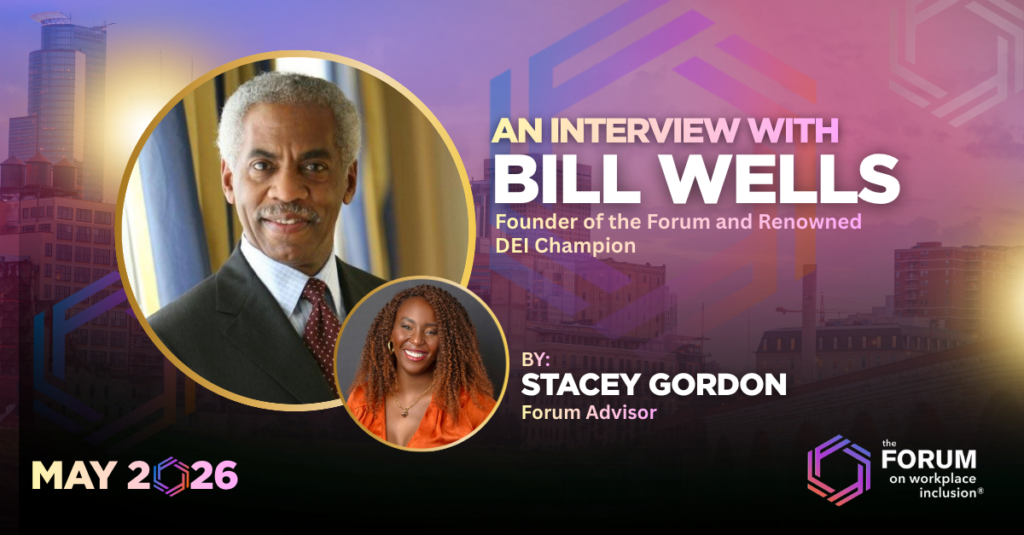
By: Stacey Gordon
Before the Forum on Workplace Inclusion was a global conference drawing thousands of professionals to Minneapolis, it was a room with 75 people and a simple idea: what if we brought corporate leaders together to talk honestly about inclusion?
Bill was there from the beginning. As a finance and marketing professional at AT&T, he wasn’t working in diversity at all — but a relationship pulled him in. The president of the Twin Cities Chapter of the National Black MBA Association, an IBM sales manager Bill already knew, asked him to get involved. Bill said yes, went to a meeting at St. Thomas, and it took on a life of its own.
I sat down with Bill to talk about the Forum’s origins, the community it created, and what he hopes to see as it comes back to life.
Stacey Gordon: What most people don’t know is that the Forum has its roots in the National Black MBA Association. How did that come together?
Bill: Everything is based on relationships. The gentleman who was president of the Twin Cities Chapter for the National Black MBA Association happened to be someone I knew — he was a sales manager for IBM Corporation. He approached me because he knew I had an interest in these sorts of things, even though I was not working in the area of diversity at all. I was an AT&T in finance and marketing.
So I went with him to the St. Thomas meeting. We sold the idea there and then it just organically started to grow. I got deeply involved with the Black MBA Association, actually became the president because he positioned me to do that. And because we had all these different corporate partners around the Twin Cities — most of them Fortune 500 companies — we started pitching their involvement with the Forum, started getting sponsorships.
SG: And it grew fast from there.
Bill: Our first really big kickoff, I think we had about 175 people. There was a company called First Bank Systems, which is now U.S. Bank. Their vice chairman, William Farley, agreed to be a keynote speaker. We took it to an offsite location, and it was a hit.
Here’s this Midwestern Caucasian man who is a very senior executive in a major firm, admitting to his own deficiency in terms of understanding issues around LGBT, around race. He was appreciative of the opportunity and then agreed to help spread the word among the CEO community here in the Twin Cities. And the rest is history.
We went from 175 people to 250 to 300, 400, 500 — and by the time we got done, it was a global international program with something like 1,200 participants from all over the globe.
SG: Over that time, what are you most proud of?
Bill: What I’m really proud of is the collaborative effort. It wasn’t just me. It wasn’t just the university. It became a family. It was a big deal. Everybody would ask me, “When’s the next event?” CEOs were saying, “How can I be the next keynote speaker?”
It started off as Twin Cities only. Then because of my affiliation with the National Black MBA Association, it became a benchmark program for the Black MBAs locally, and I got a lot of other chapters all across the country involved. They would come. And then when it went global — it was just like, where is this thing going to stop?
SG: Did the community shape or change as it grew?
Bill: We went from a three-hour session to a half-day session to a full-day session to two days, to three days. And we got St. Thomas to actually grant CEUs, so it became an accredited event. We’d get lawyers that would come because lawyers have to get their CLEs, and accountants too. So it was not just a program — it was a learning event.
SG: Considering the current climate, what would you say to a CEO right now about getting involved?
Bill: That is a huge question. We’ve seen the dismantling of DEI from the very top of this country. I watched it after George Floyd was murdered here in Minneapolis, several blocks away from my home church. I watched corporations all across this country jump up, shouting how they were going to invest in community development, how they were going to go beyond DEI. And it was really more of this humanitarian effort.
Well, that lasted for a minute.
Then politically, DEI came under attack. So what would I say to a CEO? I’d ask them: Are you true to your values? Corporate strategy comes from the very top of the organization — the mission, the vision, the values. If they did nothing more than follow their values, they wouldn’t need a DEI statement, because it’s embedded within the values and the mission of the organization.
As the CEO, your job is to provide wellness and well-being for all of your employees to drive to the bottom line. Leadership drives integrity, drives inclusion, drives equity. Why else would you want to hire people and not have them performing at the very top of their game?
Whenever I had conversations with CEOs about why they should join the Forum, it was very seldom about just driving race. It was about the fact that all people matter in the enterprise.
SG: So it’s a business conversation, not a DEI conversation.
Bill: Forget DEI as the conversation. What are your values? What are you trying to drive to? What are your external markets? For companies that are in consumer packaged goods — they’re selling products to everyone worldwide. They’re not selling to a monolithic, single-race, single-gender market. Much of it is purely business enterprise.
SG: In terms of metrics, what do you see CEOs looking at to measure whether they’ve been successful in creating an inclusive culture?
Bill: Many companies have employee engagement surveys. And I’ve asked senior leaders — at the HR level, the CEO level, people in the C-suite — if in fact they had one single measurement, what would it be?
It’s interesting. I oftentimes get CEOs say, “We’re pretty proud of our score.” And I just wait and say, “Tell me more.” “Well, we’ve got an aggregate score in the 90s.” And I say, “Good. How are you doing with women? How are you doing with people of color?”
Blank stares.
I say, you need to do some over-indexing of the data — because you’ve already got all the data. Have your analysts sort through it. Well, guess what? I’ve been with some of the biggest companies, Fortune 500 lists. They may have an aggregate score in the 90s. Then when they find out what the women’s score is, it’s sometimes in the 60s. And people of color? It’s in the 50s.
That’s one of the key indicators of how people feel about whether they’re engaged in your business. And Lord knows, if you do it with millennials, I think it’s in the 30s. Just look at the high exit rate — retention is a major issue.
SG: What’s your hope for the Forum going forward?
Bill: My hope would be how to make that connection — between values-driven leadership and real business outcomes. If leaders led from values and led from mission, I’m going to say this: they wouldn’t need an HR initiative, they wouldn’t need DEI, they wouldn’t need a forum, because it would become business strategy.
But given the reality of where we are today, things like the Forum are critical — because we’re not there. The leadership’s not there. That’s why actually, if you said one of the most proud things about the Forum, it was getting the leadership engaged. Not just showing up to give a speech, but the conversations I had with CEOs outside of the Forum — they embraced the Forum as their event.
Now, younger professonals are culture-centric. They evaluate the image and reputation of a company before they even consider going to work for it. Back in the day, we looked to see who were the big companies and focused our efforts on getting a job there. But now? If the culture is not right, they’re gone. And under culture, you can put D, you can put E, you can put I, you can put belonging — all those things fall under culture. Because culture makes the difference.
The Forum on Workplace Inclusion returns May 27–28, 2026, in Minneapolis, MN. For more information and to register, visit forumworkplaceinclusion.net.

More Forum News