Forum News & Updates
Headcount is a terrible thing to waste.
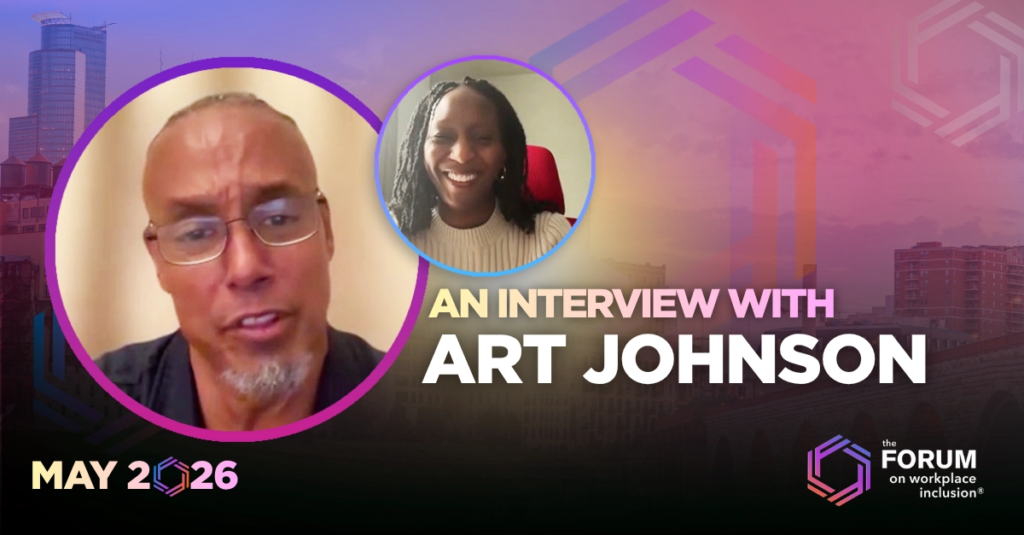
Art Johnson on Reviving the Forum on Workplace Inclusion.
After two years of silence, one of the nation’s longest-running workplace inclusion conferences is back. With a new owner, a new mandate, and a pointed message for the DEI community.
By: Stacey Gordon
For 35 years, the Forum on Workplace Inclusion was a pillar of the diversity, equity, and inclusion community — drawing as many as 2,500 professionals to Minneapolis each year to learn, connect, and push the field forward. Housed first at the University of St. Thomas and then at Augsburg University, the Forum earned its reputation as the nation’s premier workplace DEI conference, attracting keynote speakers from Magic Johnson to Van Jones to the CEO of Medtronic.
Then it went quiet. No conference in 2024. None in 2025. For many in the DEI community, the Forum’s disappearance felt like one more signal in a broader retreat.
But Art Johnson saw something different. Where others saw an ending, he saw an opening.
Johnson, the CEO of Metrics and a Minneapolis native, learned that Augsburg University was sunsetting the Forum. His team had originally reached out hoping to participate in the next event. Instead, they were asked if they wanted to acquire ownership.
He said yes.
Now Johnson is bringing the Forum back for a two-day conference on May 27–28, 2026, in Minneapolis — with a sharpened focus on measurement, unification, and proving the business case for inclusion in an era when the work has never been harder or more necessary.
I sat down with Art to understand why.
Stacey Gordon: You hadn’t attended the Forum previously, so how did you end up running it?
Art Johnson: We were looking for a place where we could put a stake in the ground and specifically talk about what we do — which is measure organizational alignment. So we learned about the Forum and contacted Augsburg College. We said, “Hey, we’d like to be a part of the next event. How do we get involved?” And they said, “Well, by the way, we’re in the process of sunsetting this.”
I thought, you’ve got to be kidding me. Something this important? As we did more digging, we learned it had been around for 35 years, with as many as 2,500 people descending upon Minneapolis. It’s a widely appreciated organization with a strong name and presence.
So when we realized the option was to either let the legacy end or continue it, it became an obvious decision that we should purchase it for the purposes of maintaining the legacy.
SG: You’ve described yourself as someone with strong opinions about the DEI space. What concerns you most?
AJ: I think there are a number of people whose careers have hit that glass ceiling and have landed in the space of chief diversity officer or executive vice president of inclusion. And while they’ve got a seat at the table, many times they don’t have power or influence.
It’s the equivalent of being invited to a shunning. I’ll let you sit at the table, but when we start serving dinner, I want you to be quiet — because we’re going to get to the important things of our business. Occasionally we’ll give you a chance to talk. But at the end of the day, what drives profit is ultimately going to decide where we go as an organization.
That concern is what led me into this concept of measuring organizational alignment — defined as the strength of harmony between strategy, structure, and culture. What we learned is that culture is the thing that sustains an aligned entity. You can get everyone on the same page for a moment in time, but if you’re trying to sustain it, you’ve got to pay particular attention to culture. Do we have a culture of continuous improvement? Continuous learning? Accountability? And the organizations that are really good at driving the right kinds of culture are ones that are inclusive — hearing from all the voices in the organization so that we get the best ideas, rather than the same ideas from the same individuals all the time.
SG: You talk a lot about measurement. Why is that the centerpiece of your vision for the Forum?
AJ: Here’s the problem. If 3M is measuring something different than the way Equitable is measuring, which is different than U.S. Bank, which is different than Target — what we have is four different measurements, and what we can’t get is best practices from that.
Unfortunately, many corporate stakeholders don’t want to discuss common platforms of measurement. They say, “We have ours already.” When I ask, “What about everybody getting on the same page?” They say, “No, we’re going to stick with what we’ve got.”
Then the question becomes — how does everybody else benefit? If you’ve built the best mousetrap, why can’t everybody else benefit from that? There’s this insular mentality: “I’m the chief diversity officer, or CHRO or whoever, and I came up with this great idea. It sometimes seems that ego is more important than progress and I’d like to discuss as a community, as an industry, how we change that.
I’ve also experienced where it is very clear in an organization that alignment is a better predictor of business outcome than engagement — but executive comp was tied to engagement scores, so they weren’t going to change anything. That’s the wall we hit.
What the Forum represents is an opportunity to help organizations figure out where they are, compare themselves to others measured the same way, and build that longitudinal data so we can identify what actually moves the metrics that matter — and tie them directly to bottom-line outcomes.
SG: What makes this so personal for you?
AJ: A very, very long time ago — probably before you were born — my parents moved us from a predominantly Black neighborhood in the inner city of St. Paul to an all-white suburb. I went from an all-Black kindergarten to an all-white first grade. I was the first and only person of color in that school, back in the early seventies.
I spent a lot of time fighting and defending myself. Trying to hold onto my lunch at the bus stop. Trying to hold my position in line to get on the bus. Fighting for every single step. And I did — scratched and clawed.
One thing I learned was how to fight. But another thing I learned is that having a voice — being able to speak up and have that voice heard — is critical.
This has been part of my life since the beginning. And now, with the opportunity to make sure that in the workplace, everybody’s got a voice, that their voice matters, that they’re included in discussions and opportunities for advancement — I’m for it.
SG: You’re relaunching at arguably the most challenging moment for DEI work in decades. Executive orders rolling back federal DEI programs, companies pulling back. Why do you see this as the right time?
AJ: One — I’m not scared. I wouldn’t have made it this far if I was scared.
Two — I think now is when we need to start figuring out how to come together. Those of like mind who want to solve these issues and make them relevant, and tie them to things that matter to anyone who wants to invest in an organization or be part of one.
I want to make sure there’s a voice. I want to make sure there’s a place. I want to make sure there’s a platform from which to speak. I want a better launching pad for ideas and a repository for the great ideas that emerge — and a way to disseminate them.
But I also want the organization to be malleable. This isn’t about Art Johnson’s ideas. I want a large group of people who feel like they can contribute. At some point you’ve got to put a stake in the ground and move forward, but you’ve got to be ready to modify as you go.
SG: DEI practitioners are dealing with two simultaneous crises — external political pressure and internal organizational fatigue. What will attendees get in two days that they can’t get from a webinar or a book?
AJ: Three things.
First — connections. Identifying people they can build lasting relationships with. People like them, and people not like them, who think differently and can broaden their perspective. The Forum has always been about community, and that doesn’t happen through a screen.
Second — actionable insights. Things they can pull from the sessions and take back to their jobs and apply immediately. And then a feedback mechanism to capture the outcome and share it with a broader group.
Third — measurement tools. If all these wonderful ideas are going to transform organizations, we need to be able to prove it. I want to make sure we have a way to measure progress, benchmark that progress, and tie it to things that matter to the board, the shareholders, and the broader organization.
SG: Anything else the DEI community should know?
AJ: There is an opportunity here to do something special. There is not a common platform for measurement in this space right now. It does not exist. If we’re trying to really make a difference, we’ve got to nail that.
For practitioners, I think there are incredible consulting opportunities ahead. But at the end of the day, what I want to see — when we talk about leaving footprints in the sand — is a way to demonstrate that people who look like us are part of organizations where they can contribute at the highest levels. That their voices are heard. And that we don’t mistake or conflate the contributions these individuals have made, because it has been measured and monitored as we’ve gone about this work.
I can’t tell you how excited I am about that. If we can get real momentum here, I think we can really make a change.
The Forum on Workplace Inclusion returns May 27–28, 2026, in Minneapolis, MN. For more information and to join the waitlist, visit forumworkplaceinclusion.net.

More Forum News