Forum News & Updates
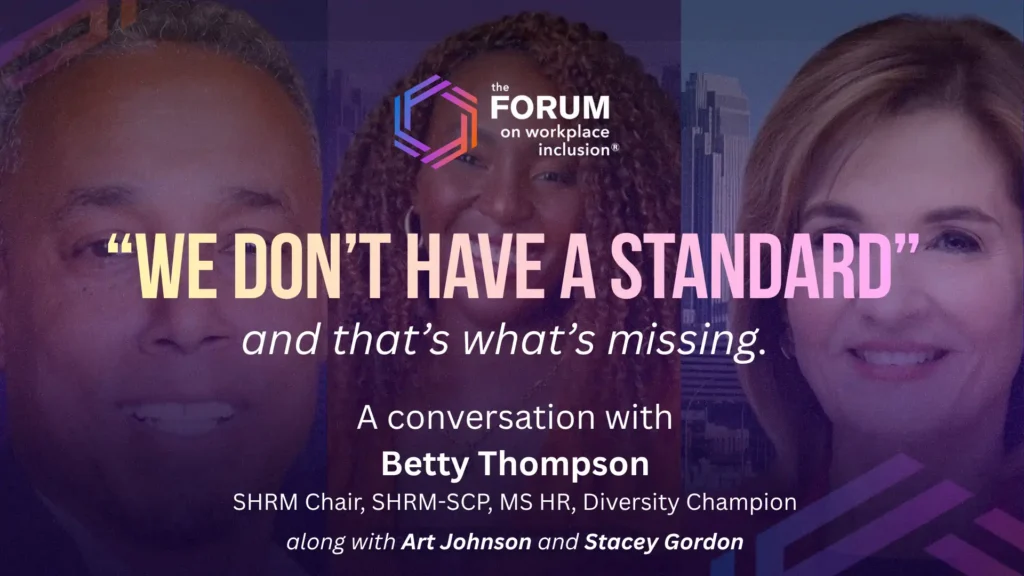
We Don’t Have a Standard, and That’s What’s Missing:
An interview with Betty Thompson on Why Inclusion Needs Clearer Metrics (and a Common Language)
By: Stacey Gordon
The Chair of the SHRM Board of Directors and former Chief People Officer at Booz Allen Hamilton makes the case for an industry-wide measurement framework — and explains why the business community won’t move without one.
🔈 Listen to the audio version of the interview
For decades, organizations have invested in diversity, equity, and inclusion. They’ve hired chief diversity officers, launched ERGs, run engagement surveys, and published annual reports. And yet, when you ask most CEOs what inclusion has done for their bottom line, the answer is often a long pause.
Betty Thompson knows this silence well. As the current Chair of the SHRM Board of Directors and former Chief People Officer at Booz Allen Hamilton, she’s spent her career at the intersection of people strategy and business outcomes. She’s watched companies embrace DEI with genuine enthusiasm — and she’s watched that enthusiasm evaporate when practitioners couldn’t connect their work to the metrics that matter in a boardroom.
I sat down with Betty — alongside Art Johnson, who now leads the Forum on Workplace Inclusion — to talk about what’s actually standing in the way of progress, and what it would take to finally give this work the measurement foundation it’s been missing.
The Real Barriers
Stacey Gordon: What do you see as the biggest barriers to creating inclusive workplace cultures right now?
Betty Thompson: I honestly think that one of the barriers is the way that we’ve been doing DEI for the last several years, which didn’t feel inclusive for everyone. And I also think the legal environment is a barrier, because people are afraid to do anything. They’re a bit paralyzed.
They’re not thinking strategically about the fact that this should be business accretive — it should improve your culture, unify the workforce, and it should be legally compliant. And that’s what scares a lot of people right now. There are companies being taken to task and paying millions of dollars because of the way they’ve been doing DEI.
SG: I always use the analogy of CPAs. There are accountants in jail for doing bad things, but nobody says, “Let’s scrap accounting principles.” We deal with the bad actors and recognize that the foundation is still necessary. I think the same is true for DEI — the problem is we haven’t had proper accountability and metrics. So how helpful do you think it would be to unify practitioners under one industry standard?
BT: I think it would be very helpful, because it would give people a bit of air cover for what they’re doing. It should be vetted to make sure that it’s legally compliant and it’s not going to get companies in trouble.
When I talk to CEOs, HR practitioners, and DEI practitioners, they all want to move forward with an inclusive workplace. They’re just very nervous about the current environment and what it means — because we don’t have a real gold standard for what “good” looks like in this new world.
The Missing Framework
SG: If we already have engagement surveys, retention data, attrition costs, and culture assessments — from Gartner, Deloitte, PwC, Catalyst — what’s actually missing? The data exists. Why isn’t it being used?
BT: I think it needs to be in the language that CEOs speak — not HR speak, not DEI speak, not practitioner speak. It has to be in business terms. It has to be things that are important to the business community, their stockholders, their boards. It has to be in the right language that it resonates with them.
Some of them really understand and want a great culture. They want to be the kind of company that cares about their people. But they need to be able to translate that into things that matter in the business — things that are tangible.
SG: So what type of metrics would CEOs actually need to take action?
BT: It can’t be that it’s just the right thing to do. It has to be more than that. And I’ve always believed that it was more than that — but we don’t necessarily have the metrics to show it.
I know during the 2008 housing crisis, there was data showing that companies with women on their boards, especially in finance, performed better than companies that didn’t. So there are some metrics. We just have to be diligent and create the standards for what those look like.
SG: It sounds like what’s missing isn’t the data itself — it’s the connection between individual metrics like retention costs and the broader metric of inclusion.
BT: Exactly. What’s missing is a framework that takes all the different ways you could measure how inclusion contributes to business outcomes, and packages it into something that resonates with business leaders, CEOs, and shareholders , so they can see the connection between these measurements and the bottom line.
You can’t talk about these things separately. There needs to be a comprehensive framework that says: this is why it matters. Whether it’s four elements or six elements, these are the things that have been proven to drive bottom-line improvement
Art Johnson: Our mantra for the Forum this year is “a headcount is a terrible thing to waste.” Betty, could you speak to that?
BT: That’s a great point. People cost money. They’re a precious resource for a company. And it’s an important aspect to make sure that you’re getting the most out of the people you have in your organization.
Figuring out a way to tie that to a tangible measurement would definitely resonate with business leaders. It would be an important data point — to show how having everyone feel like they’re contributing, that they matter, that they can bring diverse perspectives and experiences — that’s going to make a difference for the company.
Acknowledging Our Current Environment
Betty didn’t shy away from naming the forces contributing this environment. Nike, IBM, the New York Times — major organizations are being impacted. The head of the EEOC put out a public invitation for white men to come forward if they felt they’d been discriminated against.
“That’s the environment we’re in,” she said. “And that’s tough, and it’s different.”
But fear, she argued, is not a reason to abandon the work.
“We all know that there’s goodness in this work, and it is necessary. We know people want to feel that they’re contributing, that they’re seen and they’re heard,” she said. “We’re just at a point right now where we can’t lose our way. We have to keep the focus on the fact that people matter, and we need everybody to be contributing. The way to do that is to ensure that everyone feels heard, they feel seen, and they feel like they matter.”
One Standard, Not the Best Standard
The conversation kept circling back to a single point: the field needs a common denominator.
“It doesn’t even have to be the best metric,” I said. “It just needs to be a commonly agreed-upon metric.”
Betty’s response was immediate: “That’s exactly right. I love your accountant example. We don’t have that. We don’t have a standard. And I think that’s what’s missing — and that’s what could be really helpful.”
Art Johnson drew his own parallel, reaching back to his IBM days and the creation of IEEE — the Institute of Electrical and Electronics Engineers — which established universal standards so that disparate technologies could work together.
“If I take this thing and plug it into that thing, it all still works,” he said. “IEEE did that. And I see this in a very similar fashion. We just have to get to that point.”
The analogy is apt. Right now, every organization is measuring inclusion differently — different surveys, different frameworks, different definitions of success. There’s no way to compare, no way to identify best practices at scale, and no way to build the normative data that would let us say with confidence: this is what actually moves the needle.
What Comes Next
Thompson’s call for a unified measurement framework isn’t theoretical. It’s already taking shape.
At the Forum on Workplace Inclusion this May 27–28 in Minneapolis, organizers are launching a think tank designed to do exactly what this conversation describes: bring together practitioners, executives, and measurement experts to begin building a common platform — one that ties inclusion metrics to the business outcomes that CEOs, boards, and shareholders actually act on.
The goal isn’t to create the perfect framework overnight. It’s to get the right people in the room, agree on a common language, and start building the standard that this field has never had. A key leader at Blue Cross Blue Shield has already stepped up as a sponsor. SHRM’s leadership team is listening. And nearly 200 practitioners have already registered to be part of the conversation at The Forum.
If you’ve been doing this work and feeling like you can prove it’s valuable but can’t prove it in a language your leadership team will hear — or if you’ve watched your organization pull back and you’re looking for the air cover that Betty Thompson described — this is the conversation you want to be part of.
For the longest time, we assumed the business case for inclusion was intuitive. As Betty put it: “Too many companies failed to produce results from their efforts, because a lot of it, in my opinion, was window dressing and virtue signaling, as opposed to things they were really going to commit to doing.”
It’s time to stop assuming and start measuring. Together.
The Forum on Workplace Inclusion takes place May 27–28, 2026, in Minneapolis, MN. For more information and to register, visit forumworkplaceinclusion.net.
Stacey Gordon is a globally recognized keynote speaker, leadership advisor, and workplace culture strategist who helps organizations build inclusive, high-performing workplaces while navigating today’s evolving legal, social, and business landscape. She serves as an advisor to the Forum on Workplace Inclusion.
More Forum News
Q&A Webinar with Seena Hodges & Dr. Yohuru Williams
“We Don’t Have a Standard — and That’s What’s Missing”:
It Was Like a Family”: Bill Wells on the Forum’s Roots, Its Community, and Why It Still Matters